


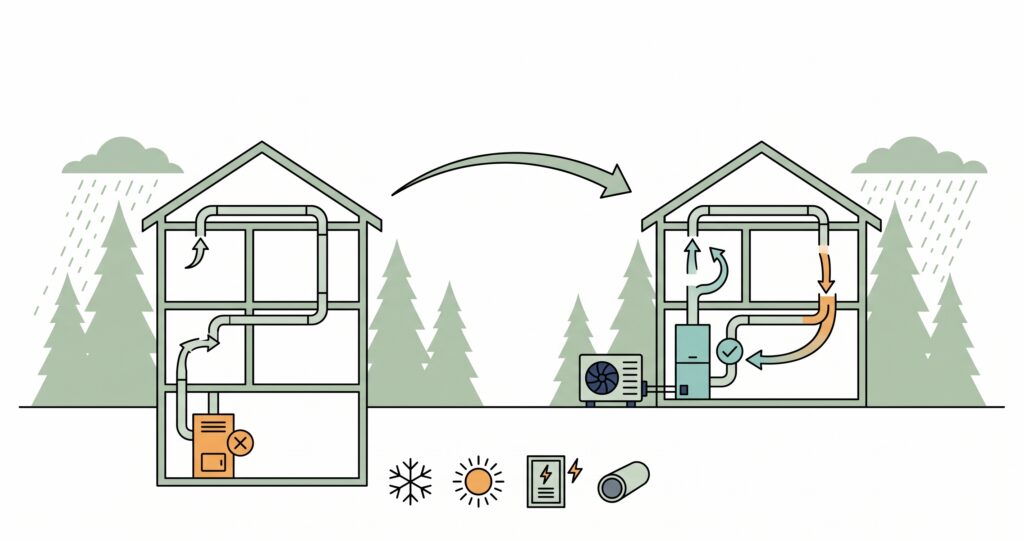
When a furnace reaches the end of its life, the default used to be another furnace. Increasingly it is not, and homeowners are being told to consider a heat pump without much explanation of what that actually means for their particular house.
THE SHORT VERSION
If your house has ducts, a heat pump uses them. You keep the vents, gain air conditioning, and the air feels gentler rather than hot. Three things decide whether it is simple or complicated: your ductwork, your electrical panel, and whether the new system is sized to the house rather than copied from the old one.
What stays the same
More than people expect. If your house has ducts, a ducted heat pump uses them. The vents stay where they are. The thermostat sits in the same place. There is still one outdoor unit and one indoor unit, in roughly the same locations as before.
From inside the house, day to day, a well-installed heat pump is unremarkable. That is the point of it.
What changes
Three things, and they are the ones worth understanding before you get quotes.
The air feels different
A furnace blasts short bursts of hot air then shuts off. A heat pump moves a larger volume of gentler air for longer. Same room temperature, but the air is not hot to the hand — and most people stop noticing within a fortnight.
You get air conditioning
A heat pump runs in reverse in summer. For a house that has never had cooling, replacing a dying furnace solves winter and the four bad weeks in August in one installation rather than two.
The bills move between fuels
Coming off gas, your gas usage drops sharply and electricity rises. Whether that is cheaper overall depends on your rates and your house. Anyone quoting a confident savings figure without seeing your bills is guessing.
The three things that decide how easy this is
| Factor | What we check | Why it matters |
|---|---|---|
| Ductwork | Duct sizing, leakage and layout, before any equipment is ordered. | Heat pumps move more air at a lower temperature. Ducts adequate for a furnace are not automatically adequate here. |
| Electrical panel | Available capacity for the new load. | Older homes with smaller panels may need a service upgrade. That is a real cost and belongs in the conversation on day one. |
| Sizing | Volume, insulation, windows, orientation and air leakage. | Oversized equipment short-cycles, giving uneven temperatures, more noise and more wear. Two similar houses can need different equipment. |
The outcome nobody wants: a new system, a large bill, and a back bedroom that is still cold. That is almost always ducts — and it is far cheaper to hear about it at the quoting stage than after installation.
But do they work in our winters?
Yes, and this region is one of the better ones for them. Heat pumps lose efficiency as it gets colder, which is a real limitation somewhere that spends February below zero. Puget Sound does not. Modern cold-climate units hold useful output well below anything we typically see here.
The variable that actually determines whether you are comfortable in January is not the brand — it is whether the unit was sized correctly and commissioned properly, meaning someone measured that it performs to specification rather than just switching it on and leaving.
The option nobody mentions: dual fuel
You do not have to choose one or the other. A dual-fuel system pairs a heat pump with a gas furnace. The heat pump does the great majority of the year; the furnace takes over on the handful of nights cold enough that gas becomes the cheaper way to make heat.
It costs more than either alone and suits a narrower set of houses — you need existing gas service, and the extra equipment has to earn its place. But for larger homes, or for people who want the efficiency without giving up a familiar backup, it is often the right answer and it rarely gets offered.
What the week looks like
Most straightforward changeouts take one to two days. The old equipment comes out, the new outdoor unit and indoor coil or air handler go in, electrical and refrigerant connections are made, ductwork is adapted where needed, and the system is commissioned and measured. Permits are pulled and inspection is scheduled.
One step worth asking any contractor about: manufacturer warranty registration. It gets skipped more often than homeowners realise, and it matters a great deal in year six. Our installation page sets out what we include.
Is it the right move for your house?
The clearest case is a house with sound ducts, a furnace over fifteen years old, and no air conditioning. Between that and the clear-cut no, it depends on the ducts, the panel and how long you plan to stay.
When we will tell you not to: a healthy furnace under twelve years old. Replacing that to chase efficiency rarely pays back, and we would rather say so.
Our heat pump installation page goes into the detail, and if you would rather stay with gas, furnace installation is still a perfectly good answer for the right house.
If your home has radiators or radiant floors instead of ducts, none of this applies in the same way — start with boiler systems or an air-to-water heat pump instead. And if there are no ducts at all, ductless is the route.
Do it before the cold
September and October are the months for this. Once the first cold week lands, equipment lead times stretch and everyone is running no-heat calls — including us. Homeowners who wait end up making a five-figure decision in a hurry.
It is also worth checking current rebates first. The federal tax credit expired at the end of 2025, which makes the remaining Puget Sound Energy and Seattle City Light programmes more important than they were.
How we can help
NW Mechanical has been installing heating and cooling across Seattle and the Eastside since 1977, from our shop in Woodinville. We install furnaces, heat pumps, ductless systems, boilers and geothermal, so we have no commercial reason to steer you toward one — and we will tell you when your current system has years left in it.
Thinking about a heat pump?
Tell us what you have and what the house does in winter. We will check the ducts, the panel and the sizing, and tell you honestly whether the swap makes sense for your home.
