


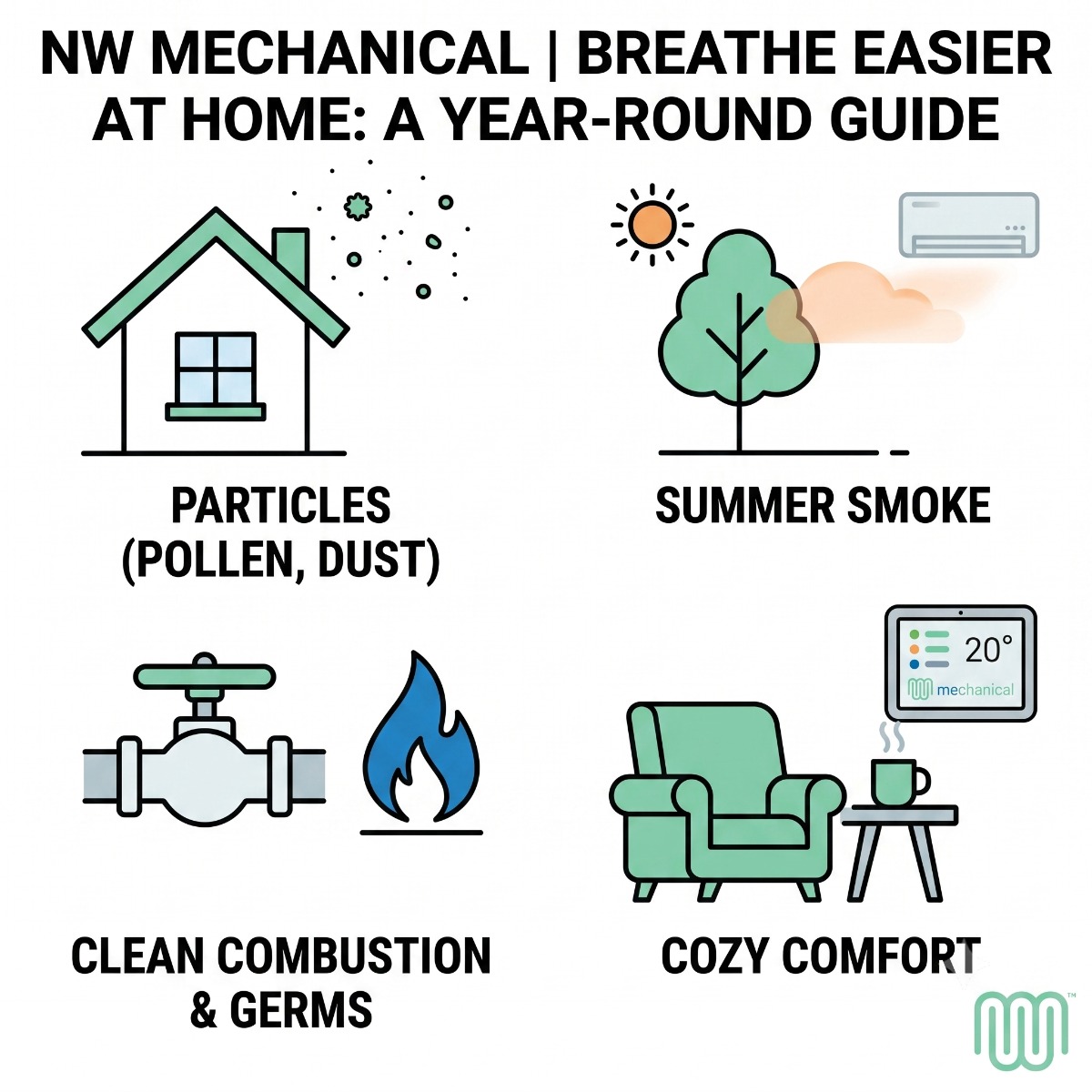
Allergies, asthma, wildfire smoke and everyday dust — practical, no-pressure advice from NW Mechanical, serving Seattle and the Eastside since 1977.
When wildfire smoke settles over Puget Sound and the sky goes flat and orange, most of us start thinking about the air we are breathing at home. Our thoughts are with the Washington families and first responders facing these fires directly.
Here is what surprises people, though: smoke is one reason among several. Around Puget Sound we are usually fortunate enough to see it clear fairly quickly once the winds shift — and long after it does, the pollen, pet dander, dust and everyday particles are still circulating through the house. Clean air is a year-round question, not a two-week one.
THE SHORT VERSION
Indoor air holds three separate problems — particles, germs, and gases and odors — and each needs its own answer. A MERV 13 furnace filter is a sensible baseline and helps with the first. Beyond that, a whole-home air cleaner handles the fine particles a filter cannot, with optional UV stages if germs or odors are also a concern. Most homes only need the particle side.
When smoke is in the air
If you are reading this during a smoke event, these are the things that make a measurable difference today, before any conversation about equipment:
Check the number, not the sky. Haze is a poor guide, and conditions vary a lot across the region. The Puget Sound Clean Air Agency and AirNow both give you the real AQI for your area.
Close the house up and keep it closed, including at night when it is tempting to open windows for the cool air.
Switch the system fan from Auto to On. This is the single most useful setting change most people can make. On Auto, the fan only runs while heating or cooling, so the air only passes the filter occasionally. On On, it circulates continuously and keeps pulling air through.
Check the filter more often than usual. Filters load fast in smoke — a filter that would normally last three months can be noticeably restricted in a couple of weeks.
Do not add to it indoors. Skip candles, avoid frying, and hold off on vacuuming unless the vacuum is HEPA-equipped.
Give the most sensitive person the cleanest room. If you have a portable HEPA purifier, it does the most good in the bedroom of whoever is struggling most, with that door kept shut.
The surprising thing about indoor air
We tend to think of air pollution as something outside. But the EPA has found that the air inside our homes is often two to five times more polluted than the air outdoors. Modern homes are built sealed and energy-efficient, which is excellent for your heating bill and means that once particles, germs and odors get in, they stay in and recirculate.
The Pacific Northwest gives indoor air plenty to work with: heavy tree and grass pollen through spring and summer, damp conditions that encourage mold, beloved pets, and smoke when fire season arrives.
Three things in the air you breathe
This distinction matters more than it sounds, because a product that solves one of these does nothing for the other two.
| The problem | What it looks like | What actually addresses it |
|---|---|---|
| Particles | Pollen, dust, pet dander, mold spores, smoke. The vast majority are smaller than one micron — far too small to see, and too small for an ordinary furnace filter to hold. | A whole-home air cleaner sized to your ductwork. |
| Germs | Bacteria, viruses and biological growth riding the air your system already circulates, and growing on permanently damp coil surfaces. | Germicidal UVC lamps inside the ductwork. |
| Gases and odors | Cooking smells, cleaning products, and chemical off-gassing from new carpet, paint and furnishings. | A UVV oxidation stage. |
Who feels it first
Poor indoor air affects everyone, but some people notice it far sooner and far more intensely: people with allergies or asthma, for whom airborne triggers mean constant congestion, coughing or flare-ups; children, whose lungs are still developing; older adults; and anyone with a heart or lung condition. For those households, cleaner air at home is not a luxury item. It is daily comfort and real relief.
Start with the simple things
Air the house out on clean days
When outdoor air quality is good and pollen is low, open it up. Check the current AQI first rather than guessing from how the sky looks.
Control the sources
Vacuum with a HEPA-equipped cleaner, keep humidity in check to discourage mold, and go easy on candles and aerosol sprays.
Upgrade the furnace filter
A MERV 13 captures far more than a standard panel. During smoke events the EPA specifically recommends MERV 13, with the system fan running continuously rather than on auto.
Do these first. They are cheap, they work, and for a lot of households they are enough. If they are not, the reason is usually that a filter cannot catch the finest particles — and cannot touch germs or odors at all.
When a filter is not enough
A whole-home air cleaner installs into your ductwork and treats the air using the heating and cooling system you already own. Because that system turns over the air in the house several times an hour, every room gets treated — no boxes to plug in, nothing to carry from room to room.
The unit we fit for the particle side is the Pristine Air AirRanger, a polarized-media air cleaner rated 97% efficient at 0.3 microns. It drops into your existing filter track — no ductwork modification — and treats the air using the system you already own, rather than sitting in one room and treating the air around it. Because it runs at a low pressure drop, it does not fight your blower the way a very dense filter does.
One important limit. This needs a forced-air system — a furnace or air handler with ductwork. If your home is heated by radiant floors, radiators or another hydronic system, or you are on ductless, whole-home purification is not a viable option, and we will say so rather than sell you one.
From there, two stages are available as options rather than as a bundle. Germicidal UVC lamps mount in the ductwork and treat bacteria, viruses and biological growth as air passes, with no chemicals and nothing released into your rooms — they also keep the coil and drain pan clear of the film that forms on any permanently damp surface. A UVV oxidation stage handles the third category: odors and chemical off-gassing.
Most homes that call us about air quality are describing a particle problem — allergies, dust, smoke — and the AirRanger on its own is the answer. The UV stages are there for customers who specifically ask for them, not a package we upsell.
There is a secondary benefit worth knowing about: keeping fine dust off your coil and blower helps the system hold its rated efficiency and can extend equipment life. You can read more on our air filtration and purification page.
Why it needs professional installation
This is not something you pick up at a hardware store. A whole-home system integrates with your ductwork and equipment, and it has to be correctly sized, installed and maintained to work properly and to keep its warranty intact. Sizing is the part people underestimate: a cleaner fitted to ductwork that cannot carry the airflow will disappoint you regardless of what the box says.
It earns its keep in every season
The useful thing about whole-home purification is that it is not a smoke-season purchase. In spring and summer it works against pollen. In autumn and winter it works against germs and cooking odors in a closed-up house. Year-round it handles dust, dander and the microscopic particles ordinary filters miss. And when the smoke does roll in, it is one more layer — alongside keeping the house closed and the fan running.
How we can help
Every home is different and we will not recommend more than yours needs. We start with an honest look at your house, your system and your family’s situation — and that might point to a simple filter upgrade, a full purification system, or just clear answers to your questions. It is how we have worked across Seattle, Bellevue, Kirkland, Redmond, Sammamish, Issaquah, Mercer Island, Woodinville, Bothell, Newcastle and the Points communities since 1977.
Going further: our air filtration and purification page covers the AirRanger, the two UV stages, what installation involves and what it costs to run. If your home has no ductwork to work with, ductless heat pumps change the conversation.
Ready to breathe easier at home?
Tell us what you are noticing — the dust, the allergies, the smell that will not shift — and we will tell you which of the three problems it is and what it actually takes to fix.
Helpful resources
The Puget Sound Clean Air Agency is the regional authority for our air, with local monitoring and burn-ban notices. AirNow.gov gives you the real-time Air Quality Index. The EPA’s indoor air quality guidance covers improving the air in your home. For regional smoke and air quality updates, the Washington Smoke Blog is the one to watch through fire season.
This article is general information and is not a substitute for medical advice. If you or a family member has a health condition affected by air quality, please follow the guidance of your healthcare provider.
